
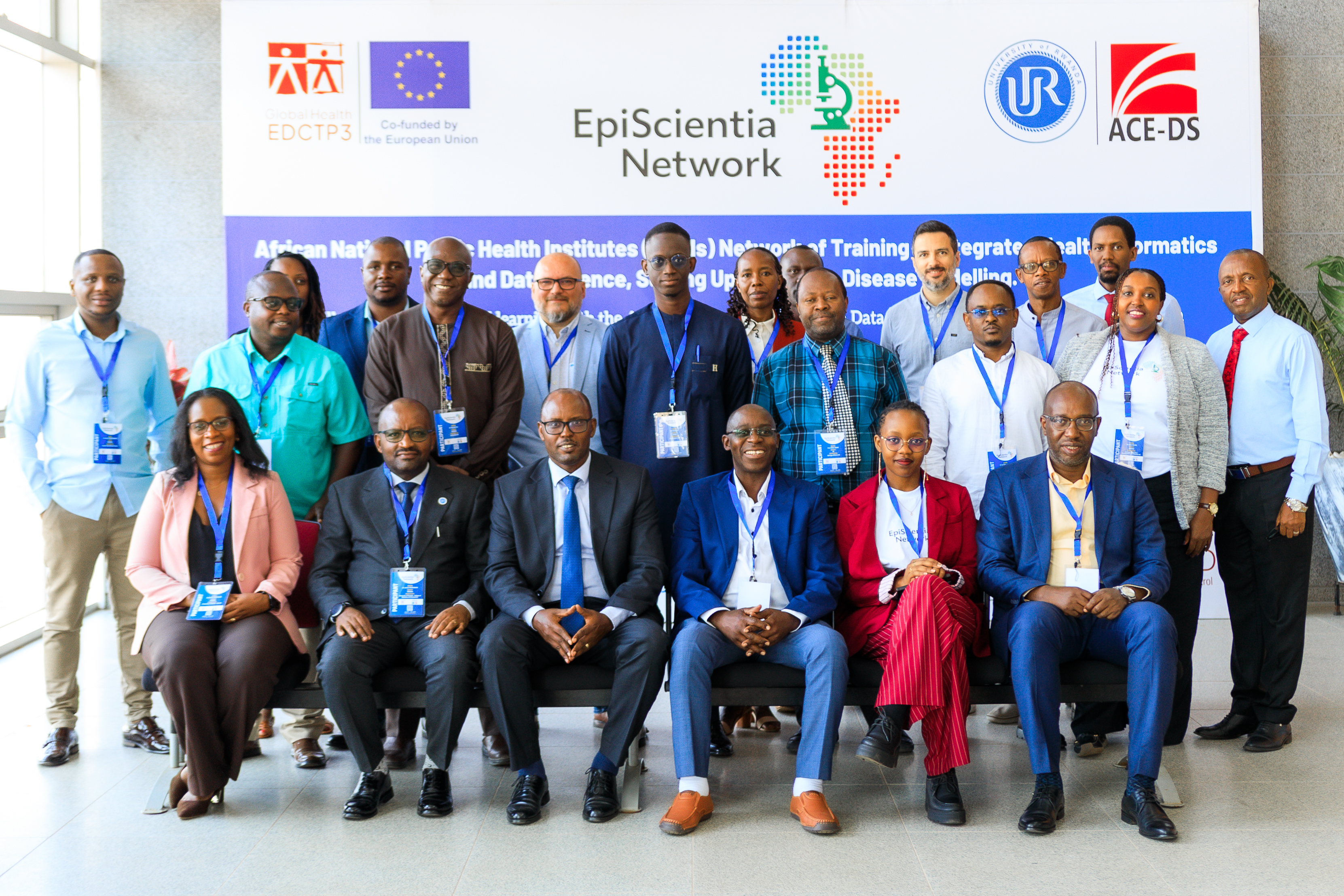
ACE-DS secures funds to train Data Scientists to enhance disease surveillance across the continent
The University of Rwanda in its African Centre of Excellence in Data Science (ACE-DS) in collaboration with 11 partners from Africa and Europe has secured funds under the project, “African National Public Health Institutes (NPHIs) Network for Training in Integrated Health Informatics and Data Science: Scaling Up Infectious Disease Modelling (EpiScientia Network)”
The EpiScientia is a training network strengthening infectious disease surveillance intelligence across Africa through work-based learning embedded within National Public Health Institutes. The project is funded by the European Union through the Global Health EDCTP3 Joint Undertaking under Grant Agreement No. 101248753.
The Centre together with partners will train professionals at different levels in a bid to address the skills gap in African National Public Health Institutes (NPHIs). Through advanced training in health informatics and data science, the initiative aims to equip public health professionals with the analytical skills needed to support evidence-based decision-making and improve responses to disease outbreaks.
The 60-month project will coordinate a multi-institutional training network involving African National Public Health Institutes (NPHIs) and European academic partners. It will train 37 skilled professionals in infectious disease data modelling through master's degree and certification programmes, deploy federated health data platforms to enable privacy-preserving analytics across participating NPHIs, and translate research findings into actionable policy briefs that support evidence-based public health decision-making.
The EpiScientia Network held its physical project kick-off meeting in Kigali, Rwanda, from 8 to 10 July 2026. Hosted by the University of Rwanda and its African Centre of Excellence in Data Sciences (ACE-DS), the meeting combined a first General Assembly session, formal project launch, technical implementation planning, and administrative and scientific reporting guidance.
The kick-off was designed to achieve three purposes: officially launch the project; enable consortium partners to know one another and strengthen working relationships; and establish a holistic view of the action, including work packages, deliverables and implementation dependencies. The proceedings confirm the centrality of work-based training for National Public Health Institute personnel, the role of ACE-DS in the MSc and certification pathways, and the importance of secure, harmonised and federated health-data infrastructure.
In a three -day official launch meeting, the Principal of College of Business and Economics Dr. Joseph Nkurunziza noted that the EpiScientia initiative is both timely and strategic.
“By investing in work-based learning embedded within National Public Health Institutes, the project will help bridge critical skills gaps while ensuring that knowledge is immediately translated into stronger surveillance systems and evidence-informed public health decision-making”, he said.
The Vice Chancellor of the University of Rwanda Prof. Kayihura Muganga Didas underscored the strategic importance of the initiative in strengthening Africa's public health systems.
"The EpiScientia Network symbolizes a strategic investment in Africa's capacity to generate evidence, anticipate emerging health threats, and inform policy through science and innovation”, he said.
He added, “Universities must increasingly become engines of national and continental transformation, and EpiScientia exemplifies that responsibility by strengthening research, innovation, and collaboration in public health."
The EpiScientia Network's mission is to build a sustainable workforce capable of transforming health data into actionable intelligence for infectious disease prevention, surveillance, and control.
The consortium combines expertise from leading universities, research institutions, and public health organizations across Africa and Europe, creating a collaborative platform for capacity building, research, and innovation in infectious disease modelling and integrated health informatics.
In his closing remarks, the Principal of the University of Rwanda's College of Business and Economics Dr. Joseph Nkurunziza commended the consortium for its commitment to strengthening Africa's capacity to prevent and control infectious diseases.
He reaffirmed the University's support for the network and pledged continued collaboration to advance its mission of developing skilled professionals and innovative solutions for public health across the continent.
- Log in to post comments


